Introduction to Cellular Allografts
Cellular allografts are donated human tissue products that contain living (or once-living) cells and are used to support healing and regeneration. Unlike a traditional graft taken from a patient’s own body (an autograft), an allograft comes from a donor and is processed under strict safety and quality standards before being used in clinical care.
In today’s regenerative medicine landscape, “cellular allograft” is an umbrella term that can include different tissue sources, cellular compositions, and processing methods. Understanding the major types helps clinicians and patients make more informed choices—especially when goals like faster healing, better tissue quality, or reduced donor-site morbidity matter.
What Makes an Allograft “Cellular”?
An allograft is generally considered “cellular” when it retains native cells (or viable cellular components) that can contribute biologic signals important for repair. In many products, the value comes from a combination of:
- Cells (such as fibroblasts, chondrocytes, or stem/progenitor-like cells)
- Extracellular matrix (ECM) that provides structure and scaffolding
- Growth factors and signaling molecules that help coordinate healing
Not every allograft on the market contains viable cells, and labeling can be confusing. Some products are primarily ECM-based and only minimally cellular after processing, while others are specifically designed to preserve or deliver viable cells.
Types of Cellular Allografts
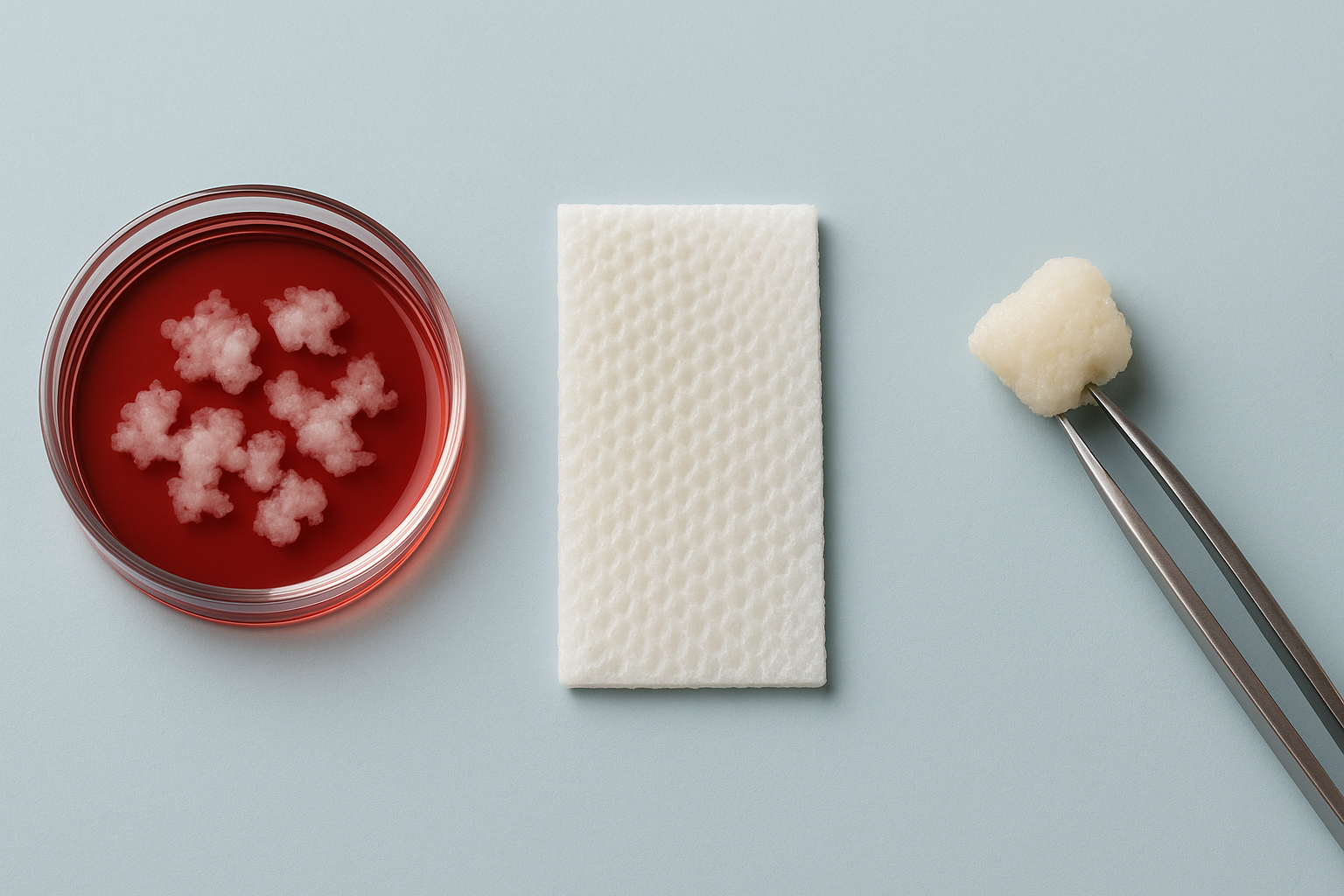
Cellular allografts can be grouped in a few practical ways: by tissue source (skin, amnion, cartilage, bone), by form (sheet, particulate, injectable), and by intended clinical application (wound healing, orthopedics, spine, sports medicine). Below are widely recognized categories clinicians commonly discuss when comparing options.
1. Amniotic and Placental-Derived Cellular Allografts
Amniotic membrane and placental tissues are well known in wound care, ophthalmology, and certain musculoskeletal applications. These tissues are naturally rich in ECM components and bioactive molecules, and depending on processing, they may retain varying degrees of cellular content.
Common forms:
- Amnion or chorion sheets (single or multilayer)
- Dehydrated or cryopreserved membranes
- Micronized/particulate powders and injectables (product-dependent)
Typical uses: chronic wounds, surgical incisions, burns, tendon/ligament support, and soft tissue repair where a biologically active barrier or scaffold may be helpful.
What to know: “Placental allograft” can mean very different things depending on whether the product is dehydrated, decellularized, or cryopreserved. If viable cells are important to your decision-making, it’s worth confirming what the manufacturer claims and what testing supports it.
2. Skin and Dermal Cellular Allografts
Dermal allografts are often used when the goal is to provide structural support and a dermal-like matrix that can integrate with the patient’s tissue. Some dermal products are processed to preserve cellular elements, while others are intentionally decellularized to reduce immunogenicity.
Common forms:
- Dermal sheets (for coverage, reinforcement, or reconstruction)
- Composite products combining epidermal/dermal components (varies by indication)
Typical uses: complex wound management, reconstructive procedures, soft tissue reinforcement, and coverage where durable matrix support matters.
What to know: In clinical conversations, you’ll often hear dermal allografts described by whether they’re cellular or acellular. Cellular dermal options may aim to preserve native cells, while acellular dermal matrices focus on scaffold strength and remodeling.
3. Bone Marrow–Derived Cellular Allografts
Bone marrow–derived cellular allografts are commonly discussed in orthopedic and spine settings. The concept is to deliver an osteogenic (bone-forming) cell population and supportive signals to areas where fusion or bone repair is needed.
Common forms:
- Cellular bone matrices (CBMs) combined with mineralized bone chips or demineralized bone matrix (DBM)
- Putty or moldable formats for packing defects or fusion sites
Typical uses: spinal fusion procedures, filling bone voids, and supporting bone healing in select orthopedic surgeries.
What to know: These products are often compared based on handling characteristics, storage requirements (some are cryopreserved), and clinical evidence. As with all cellular products, viability claims can vary by processing and storage.
4. Cartilage and Chondral Cellular Allografts
Cartilage-focused cellular allografts are used in joint preservation and sports medicine, where repairing cartilage defects can be challenging due to cartilage’s limited ability to self-heal. These allografts may include viable chondrocytes or cartilage-derived cellular components within a supportive matrix.
Common forms:
- Particulate cartilage allografts
- Osteochondral (bone + cartilage) grafts in selected cases
- Scaffold-based constructs designed for defect filling
Typical uses: focal cartilage defects in the knee or other joints, cartilage restoration procedures, and situations where a cartilage-like matrix may improve outcomes.
What to know: Cartilage restoration is highly technique- and patient-dependent. Lesion size, location, alignment, and activity level often matter just as much as graft selection.
5. Umbilical Cord and Wharton’s Jelly–Derived Cellular Allografts
Umbilical cord tissues, including Wharton’s jelly, are discussed for their ECM richness and biologic signaling potential. Some products in this category are processed to preserve more native components than others.
Common forms:
- Sheets and wraps
- Particulate forms
- Injectable preparations (depending on regulatory pathway and product design)
Typical uses: soft tissue support, wound applications, and certain musculoskeletal uses where clinicians want an ECM-rich scaffold.
What to know: As with placental products, “umbilical-derived” can cover a wide range of processing methods. When comparing options, focus on indications, handling, and published evidence rather than category labels alone.
6. Adipose-Associated Cellular Allografts (Category Notes)
Adipose (fat) tissue is a known source of regenerative cells in autologous settings, and allogeneic approaches are an area of continued interest. Availability and how these products are regulated can vary, and not every adipose-related product is considered a traditional “cellular allograft” in the same way as bone, placental, or dermal tissues.
Typical uses: may be discussed in soft tissue and regenerative applications, depending on local regulations and product classification.
What to know: Because definitions and regulatory considerations differ by region and processing level, it’s important to clarify what exactly a product contains and what it’s cleared/approved for in your setting.
How to Compare Cellular Allograft Options
If you’re evaluating different types of cellular allografts, a few practical questions can quickly narrow the field:
- What is the tissue source? Placental, dermal, bone marrow, cartilage, etc.
- Is the graft viable, and what supports that claim? Ask about processing, storage, and viability testing.
- What is the form factor? Sheet, particulate, putty, injectable—handling matters in the OR or clinic.
- What’s the clinical evidence? Look for indications aligned with your use case and patient population.
- What are storage and logistics requirements? Cryopreserved vs. room temperature options can affect workflow.
Conclusion
Cellular allografts span several tissue types—amniotic/placental, dermal, bone marrow–derived, cartilage-based, and umbilical-derived—each with strengths that align with specific clinical goals. The best choice usually comes down to the indication, the product’s cellular and ECM characteristics, handling needs, and the quality of supporting evidence. When in doubt, ask targeted questions about tissue source, processing, viability, and clinical data to make comparisons clearer and more meaningful.